A good leather-making workshop is not just a hobby session. It is a compact lesson in design, materials, engineering, and patience. That matters more in 2025 than it did a few years ago, because leather now sits at the intersection of craftsmanship, sustainability, and product transparency. Leather Working Group says more than 2,200 suppliers in 60-plus countries are certified through its system, and over a third of global finished leather production is assessed using its audit standard. At the same time, 2024 trade data still shows strong international demand for leather goods, with the EU exporting about $538.9 million in articles of leather or composition leather and China about $407.9 million in that category alone. In other words, leather is still commercially important, but the expectations around how it is sourced, made, and explained are much higher now.
That is exactly why workshops matter. They turn leather from an abstract luxury material into something people can actually understand with their hands. Once you cut a hide, punch a stitch line, or burnish an edge yourself, you stop judging a leather product only by brand name or price tag. You start noticing grain consistency, edge finishing, stitch spacing, hardware quality, and construction logic. That shift is what makes a workshop valuable for hobbyists, designers, small brands, and even retail customers who want to buy better.
Why the workshop experience matters now
Leather education is becoming more important at the same time formal training routes remain relatively narrow. The UK’s official apprenticeship portal shows just one training provider for the Level 2 Leather Craftsperson apprenticeship, while Walsall Leather Skills Centre continues to position itself as a place serving everyone from complete beginners to advanced practitioners and supporting Level 2 and Level 3 apprenticeship routes. That makes short workshops more than a leisure activity. In many cases, they are the first real entry point into a specialist trade.
There is also a wider skills context behind this. In the Crafts Council’s 2025 Makers Survey, 47.3% of respondents said they had not taken part in any professional development activity in the previous 12 months. Only 16.9% reported training on a new craft, and just 8.2% reported mentoring, apprenticeships, or placements. The same report flags loss of traditional skills and closure of craft courses as major concerns. That makes practical, short-format learning more important than it sounds on paper.
What a leather-making workshop actually teaches
At beginner level, a leather workshop usually teaches three things at once.
Material literacy
Leather is not one material in the way cotton or steel is one material. Thickness, temper, finish, tanning method, and surface treatment all change how it behaves. London Leather Workshop’s introductory course, for example, explicitly teaches leather types, tanning, finishing, and best-use decisions before students move into construction. That is important because many mistakes in leatherwork are material-selection mistakes, not stitching mistakes.
Tool discipline
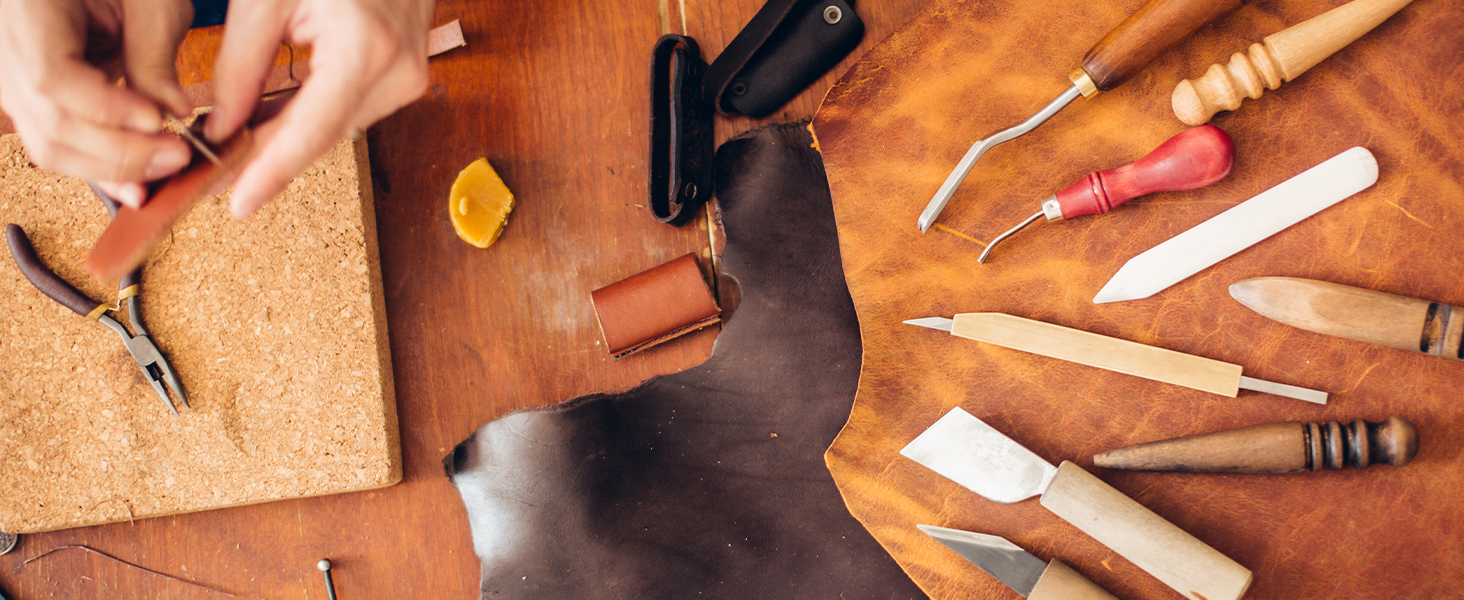
Leather rewards accuracy and punishes rushing. A workshop introduces people to knives, punches, edge tools, creasers, skiving tools, mauls, and stitching equipment in a controlled sequence. That matters because leather cannot always be “hidden” after a bad cut or misplaced hole. Unlike fabric, it keeps a visible record of weak technique. Good instructors teach tool handling first because precision is part of the craft, not an optional extra.
Construction logic
The real lesson in leatherwork is learning why products are assembled in a particular order. A wallet, belt, pouch, or cardholder looks simple from the outside, but each one forces the maker to think about seam allowance, fold direction, reinforcement, hardware placement, and finishing order. That construction thinking is what turns a workshop from a craft demo into applied product design. WorkshopSF’s beginner wallet class, for instance, teaches participants to cut, dye, stamp, hand-stitch, and attach hardware in sequence around a simple pattern.
Inside the workshop: what happens from start to finish
Most well-run leather workshops follow a surprisingly logical progression:
- Material briefing: students learn what leather they are using, how it was finished, and why it suits the chosen project.
- Pattern and marking: the instructor explains placement, grain direction, and how to mark accurately before cutting.
- Cutting and preparation: participants cut the components and may bevel, skive, or reinforce specific areas depending on the project.
- Assembly: learners glue, punch, stitch, and sometimes add lining, straps, zips, or hardware.
- Edge finishing: this is where many pieces begin to look professional, through burnishing, edge paint, or crease work.
- Quality review: the best workshops end by showing what makes the finished object look refined rather than homemade.
For beginners, the project is usually intentionally small. J.H. Leather’s Walsall group classes use beginner formats such as a hand-stitched coaster and cardholder, while Leatherbox offers a 2.5 to 3 hour fundamentals workshop focused on hand-stitching, edge finishing, and skiving. London Leather Workshop offers a more intensive beginner-friendly introduction running up to 7 hours in one day. That range tells you something useful: a workshop can be a taster session, a full-day skill immersion, or the start of a professional pathway.
What changes as you move from beginner to advanced
The biggest shift is not that the projects get larger. It is that the decisions get less obvious.
A beginner can make a cardholder by following instructions. An intermediate maker has to start choosing between hand sewing and machine sewing, burnished versus painted edges, soft versus structured construction, and different reinforcement methods. London Leather Workshop’s more advanced teaching sequence shows that clearly: later stages move into straps, zips, linings, gusset construction, closures, hand sewing, and prototyping decisions. Walsall’s course list shows the same progression in a different format, with one-day workshops at one end and multi-week courses in harness, bridle, saddle, and pattern-cutting technology at the other.
This is where leatherwork becomes especially valuable for product developers and small business owners. Once someone understands construction, they can prototype intelligently, communicate better with makers, and identify why one product lasts longer than another. The workshop experience becomes a practical education in quality control.
Sustainability is changing what leather workshops talk about
A modern leather workshop is no longer only about technique. It increasingly includes questions about environmental impact, traceability, and material choice.
Leather Working Group’s 2024 life-cycle assessment was built to give up-to-date environmental insight into leather production. It assesses one square meter of finished leather, covers impact categories such as global warming potential, water use, freshwater ecotoxicity, and eutrophication, and spans 50 products across six product families from raw material sourcing through finished leather manufacturing. That matters in workshops because material education is becoming more evidence-based. A serious instructor today cannot talk about leather quality without eventually talking about sourcing, chemistry, and process impact.
Regulation is pushing the same direction. In April 2025, the European Commission launched consultation work on the Digital Product Passport under the 2024 Ecodesign for Sustainable Products Regulation. The Commission says the passport is meant to store and share information about sustainability, durability, and other environmental aspects so consumers, businesses, and authorities can make more informed decisions. For leather workshops and small makers, that trend has a practical implication: storytelling is moving from vague claims toward traceable product information.
There is also a visible shift toward reclaimed and recycled inputs. In 2025, Reuters reported that Tapestry increased its stake in recycled-leather company Gen Phoenix. Reuters also noted that Coachtopia products contain at least 50% recycled leather content, and Gen Phoenix estimated its recycled leather fibers can cut carbon emissions by about 80% versus virgin leather. That does not mean every workshop should switch away from traditional hides, but it does show where the broader market is heading. Workshops that teach repair, efficient cutting, and the use of offcuts are becoming more commercially relevant, not less.
Who gets the most value from a leather workshop
The answer is broader than most people expect.
- Beginners get a reliable first project and a realistic sense of whether the craft suits them.
- Design students learn why flat sketches and finished objects are not the same thing.
- Brand founders learn enough construction language to prototype better and brief manufacturers more clearly.
- Retail customers and collectors become better judges of quality, which changes how they buy and care for leather goods.
A simple real-world example makes this clear. Someone who has made a wallet in a workshop will usually never look at a cheap, badly finished wallet the same way again. They know how long edge work takes. They know why stitch consistency matters. They understand that clean corners, even tension, and good leather selection are not decorative details. They are the product.
How to choose the right leather workshop
Not every workshop is designed for the same outcome. Before booking, check for these signals:
- Project clarity: the workshop should say exactly what you will make and what techniques you will practice.
- Material transparency: good providers explain the leather type, not just the finished object.
- Skill progression: the best studios offer a path from taster class to deeper technical learning.
- Tools and class size: smaller classes usually produce better hands-on correction. London Leather Workshop caps its Module 1 class at six students.
- Take-home knowledge: supplier lists, handouts, samples, or pattern references are a strong sign the class is built for long-term learning.
A workshop is worth more when it teaches transfer skills, not just one finished object. The goal is not simply to leave with a cardholder or belt. The goal is to leave understanding why it came together the way it did.
Conclusion
The art of leather making is really the art of controlled decisions. A workshop reveals that every polished piece of leather goods is the result of choices about material, pattern, pressure, sequence, finish, and durability. In 2025, that knowledge is more valuable because the leather sector is being shaped by tighter scrutiny, stronger sustainability expectations, and a growing need to preserve real craft skills. Trade data shows leather remains economically relevant, while industry and policy signals show that transparency and better material literacy are becoming essential. That is why the workshop experience matters: it does not just teach people how to make something beautiful. It teaches them how to see leather properly. And over the next few years, as traceability rules and recycled-material innovation move further into the mainstream, that hands-on understanding will only become more useful.
FAQs
What is a leather-making workshop?
A leather-making workshop is a hands-on class where people learn how to cut, stitch, shape, and finish leather products.
Who can join a leather workshop?
Beginners, hobbyists, design students, and small business owners can all benefit from a leather workshop.
What do you usually make in a beginner workshop?
Most beginner workshops focus on simple items like cardholders, belts, coasters, or small wallets.
Why is leather selection important in a workshop?
Different types of leather vary in thickness, softness, and durability, which affects how the final product looks and performs.
What skills do you learn in a leather workshop?
You usually learn cutting, marking, stitching, edge finishing, tool handling and basic construction techniques.
How long does a leather workshop usually last?
Leather workshops can range from a few hours to full-day sessions, depending on the project and skill level.
Is a leather workshop only for hobby learning?
No, it can also help product designers, brand founders, and makers understand quality and construction better.