Preschool science is often treated like something that can wait until real school begins. That is a mistake. UNESCO describes early childhood care and education as spanning birth to age 8 and identifies it as the foundation for cognitive, socio emotional and physical development, school readiness and lifelong learning. At the same time, access is still limited: UNICEF’s latest global data says only about 4 in 10 children aged 3 to 4 attend early childhood education programmes worldwide. In other words the years when curiosity is naturally highest are still underused for structured science rich learning.
That gap matters even more now because children are growing up in a more environmentally unstable world. UNICEF reports that about 1 billion children already live in countries facing high climate and environmental risk and its 2025 climate snapshot found that at least 242 million students in 85 countries had their schooling disrupted by extreme climate events in 2024 alone. Add urbanization to the picture with UNICEF projecting that 3 in 5 children will live in cities by the 2050s and the case for nature connected, hands-on science learning becomes much stronger. Preschool eco workshops are not a trend piece. They are a practical response to how childhood is changing.
Why the preschool years are a prime window for science learning
Young children are already acting like scientists. They notice patterns, test ideas, compare materials, ask why and revise their thinking when something surprising happens. The problem is not children’s readiness for science; it is adults’ tendency to underestimate it. A 2025 meta-analysis of 31 classroom-based pre-K to 1st-grade science intervention studies found a pooled average effect of +0.33 standard deviations on science achievement. The authors note that this translates roughly to a typical child in the intervention group performing around the 63rd percentile, compared with the 50th percentile for a similar child in a control group. That is a meaningful lift from early science experiences, not a marginal one.
Just as important, the same meta-analysis found suggestive positive spillover effects on literacy, social-emotional learning, and teacher-level outcomes. That matters because preschool leaders often feel pressure to justify science time against language or readiness goals. The evidence points the other way: well-designed early science does not compete with broader development; it can support it.
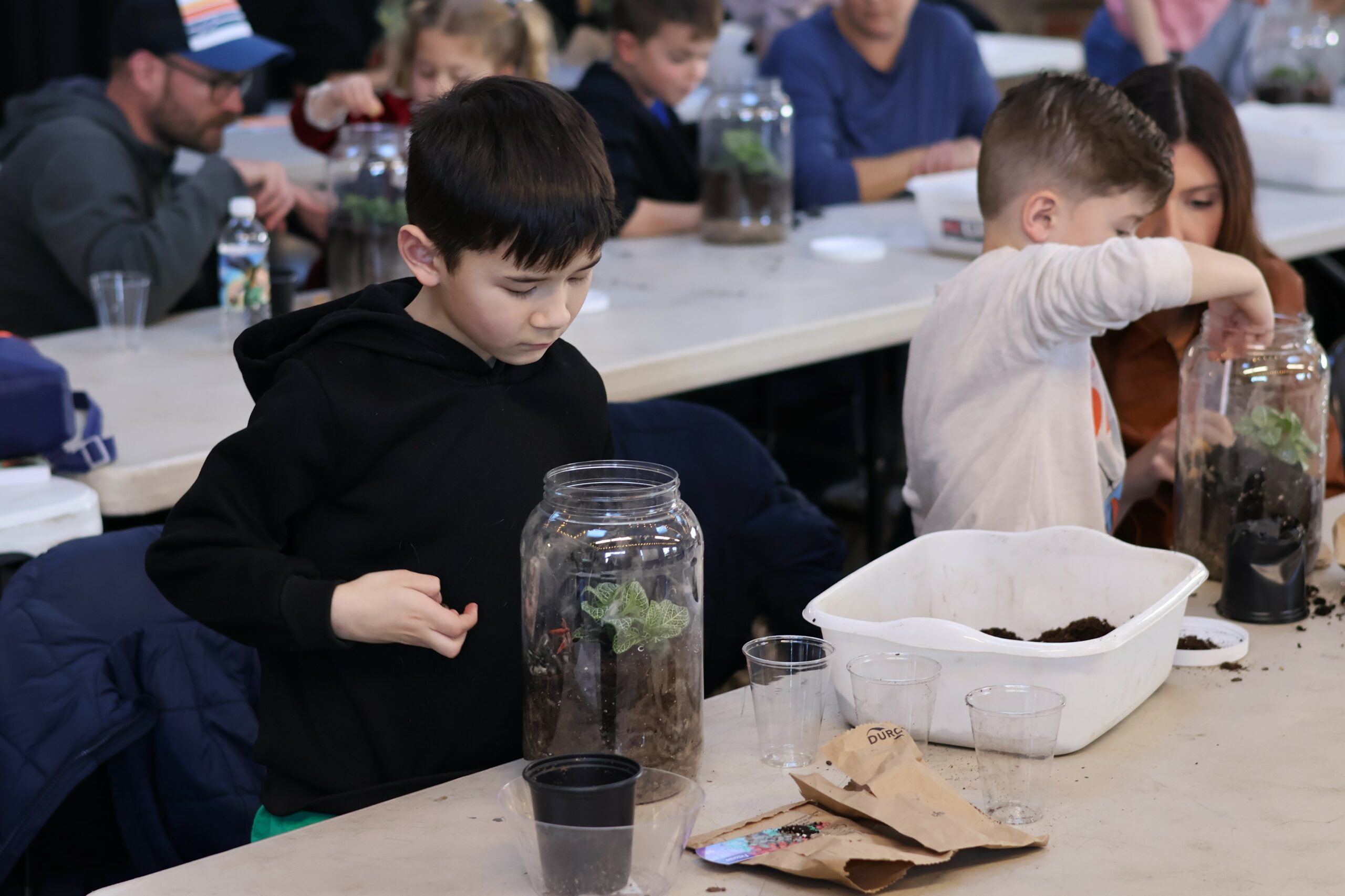
This is exactly why eco workshops work so well in preschool. According to NAEYC, inquiry-based STEAM experiences give young children active, hands-on opportunities to build vocabulary, critical thinking, problem solving, communication, reflection and data-gathering habits. In practice, that can be as simple as charting weather, comparing wet and dry soil, observing where worms appear after rain or testing which classroom spot helps a seedling grow faster. Those are not cute activities. They are early lessons in evidence, systems, and cause and effect.
What preschool eco workshops teach that worksheets cannot
Observation becomes a habit, not a one-off task
A worksheet can ask a child to circle a plant. An eco workshop asks the child to notice that one leaf is waxy, another is dry, one soil cup holds water, another drains quickly and one tray attracts more insects after watering. That shift matters because science skill begins with noticing. Inquiry-focused early learning encourages children to collect information before they are given answers.
In a good eco workshop, children repeatedly practice the core moves of science:
- observing closely
- comparing and classifying
- making predictions
- testing ideas with real materials
- describing what changed and why
Those habits are portable. A child who learns to compare pebbles, leaves, shadows and water flow is building the same mental architecture later used for experiments, graphing and evidence-based reasoning.
Sustainability becomes concrete instead of abstract
One reason sustainability education often fails with young children is that adults make it too conceptual. Terms like “climate action” or “resource conservation” do not mean much to a four-year-old. But turning off unused lights, saving water during a planting activity, sorting compostable scraps, or noticing that plants droop without sunlight are graspable experiences. A 2026 Scientific Reports study summary on early science and sustainability found that when teachers tied science learning to everyday routines, children developed practical awareness around behaviors such as saving water, switching off lights and disposing of paper properly.
That is the real strength of preschool eco workshops: they shrink big environmental ideas down to child-sized evidence.
School readiness gains can happen without sacrificing wonder
A frequent concern is that outdoor or nature rich learning may be enjoyable but academically soft. Recent evidence does not support that assumption. A 2025 study comparing children in a nature-based preschool with those in a non nature setting found that the nature-based classrooms spent about two hours more outside on average, yet children in both settings developed early literacy, working memory and inhibitory control at similar rates. The takeaway is not that every nature programme automatically outperforms traditional classrooms. It is that strong nature rich programmes can support key school readiness outcomes while offering a different, often more inquiry driven learning environment.
That nuance is important. The same study found stronger growth in one behavioral self-regulation measure for children in the non nature setting, which is a useful reminder that eco workshops should be intentionally designed not romanticized. Nature alone is not the pedagogy. Adult framing, questions, sequencing and reflection still matter.
How eco workshops support the wider skills behind science success
Science learning in preschool is not only about content such as plants, insects, weather, or recycling. It also builds the less visible capacities that make later learning stick.
A 2024 peer-reviewed study involving 115 children across nine preschool programmes found that nature-based practices showed potential to support self-regulation, particularly hot executive function, with especially promising effects for children from lower socioeconomic backgrounds in public preschool. That finding matters because self-regulation underpins attention, turn-taking, waiting, frustration tolerance, and task persistence, all of which influence how children function in group learning settings.
This is where preschool eco workshops have an advantage over more scripted lessons. Waiting to see if seeds sprout, taking turns pouring water, remembering yesterday’s observations, and adjusting a prediction after a failed test all require executive function in action. The science content and the behavior skill are being built together.
Why preschool eco workshops matter more in 2024–2026
The context around early learning has changed. Climate education is moving into mainstream policy and school design, not staying on the margins. UNESCO’s Greening Education Partnership, highlighted in a 2025 Pakistan climate-smart education workshop, brings together more than 80 Member States and 1,300 organizations across pillars that include greening schools, curricula, teacher training, and communities. UNESCO has also introduced tools such as “Sustainability from the Start,” a digital application designed to help educators working with children up to age 8 embed sustainability into early learning.
UNESCO’s 2024 Green School Quality Standard makes the direction of travel even clearer. It frames sustainability as something that should shape day-to-day school operations, teaching and learning inside and outside the classroom, and school-community interaction, with continuity from the early years through higher education. It also sets an ambitious global aim: contributing to 50% of the world’s schools becoming green by 2030.
For preschools, enrichment brands, and workshop providers, that suggests an important business shift. Eco workshops are no longer just “nice extras” for marketing brochures. They are becoming part of how high-quality programmes demonstrate relevance, future-readiness, and alignment with where education systems are headed. That is an inference from the policy direction, but it is a grounded one.
What a high-quality preschool eco workshop actually looks like
The best workshops do not try to teach everything about the environment in one session. They focus on one phenomenon, one question, or one living system at a time.
A strong design usually includes the following:
- a real-world question, such as “Why do some plants droop faster?” or “What happens to scraps in compost?”
- hands-on materials children can manipulate directly
- prediction before explanation
- repeated observation over time, not a single activity burst
- teacher prompts that extend thinking instead of supplying answers
- simple documentation through photos, drawings, marks, or weather charts
- a practical care action, such as watering, sorting waste, or checking light exposure
That structure lines up well with inquiry-based early learning and with the evidence showing that a range of early science strategies can be effective when children are actively engaged.
Three workshop formats that work especially well
Seed-to-sprout lab
Children plant seeds in cups with different light or water conditions, predict outcomes, and track changes over a week or two. This builds observation, vocabulary, comparison, and cause-and-effect reasoning.
Mini weather station
Children record daily sun, cloud, wind, or rain conditions, then compare patterns at the end of the week. This introduces data collection, pattern recognition, and early graph thinking.
Recycling and decomposition investigation
Children sort classroom waste, bury or seal sample materials, and observe what changes over time. This makes the difference between reuse, waste, and organic breakdown visible.
These activities work because they keep science physical, visible, and discussable.
Common mistakes that weaken eco workshops
Not every “green” preschool activity builds science skill. The weaker versions usually fall into familiar traps:
- treating sustainability as a slogan instead of a question children can investigate
- giving children facts before letting them observe
- using outdoor time as a break rather than a learning environment
- over-relying on craft projects that look thematic but require little reasoning
- skipping documentation, which makes it harder for children to revisit evidence
- assuming nature exposure alone will produce strong outcomes without intentional teaching
Research on inquiry, playful learning, and nature-based preschool makes the same point from different angles: child agency matters, but teacher design still matters too.
Practical takeaways for schools, parents, and workshop providers
For schools, the most effective move is to treat eco workshops as part of the learning model, not as occasional event days. Build them into the calendar, document learning visibly, and connect them to vocabulary, counting, storytelling, and reflection.
For parents, look beyond whether an activity is “fun.” Ask whether children are predicting, observing, revisiting, and explaining. A messy planting table is not automatically science; a structured question around that planting table is.
For workshop providers, the opportunity is to design programmes that are both educationally rigorous and developmentally appropriate. The strongest offers will combine clear learning goals, teacher guidance, simple assessment methods, and sustainability themes children can actually experience.
Conclusion
Preschool eco workshops sit at the intersection of three urgent needs: better early science learning, stronger school readiness, and more meaningful sustainability education. The research now shows that early science interventions can produce measurable gains, that nature-rich preschool environments can support important readiness outcomes and that sustainability concepts become far more powerful when children encounter them through real materials and repeated inquiry rather than slogans alone.
The future outlook is hard to ignore. Climate risk is already interrupting children’s education, urban life is distancing many children from daily contact with nature, and international education bodies are pushing schools toward greener, more integrated models. In that environment, preschool eco workshops are not a decorative add-on. They are one of the clearest ways to build scientific thinking early connect learning to the real world, and help children grow into curious, capable problem-solvers who understand that caring for the environment begins with paying attention to it.
FAQs
What are preschool eco workshops?
Preschool eco workshops are hands-on learning sessions where young children explore nature, plants, recycling, water, soil and simple science concepts through play and observation.
Why are eco workshops useful for preschool children?
They help children build early science skills, curiosity, problem-solving ability, and awareness of the natural world in an age-appropriate way.
What science skills can children learn in these workshops?
Children can learn observation, prediction, comparing results, asking questions, identifying patterns, and understanding simple cause-and-effect relationships.
Are eco workshops only about plants and gardening?
No, they can also include weather activities, composting, recycling, insects, water experiments, and other nature-based science topics.
How do eco workshops support school readiness?
They improve attention, vocabulary, communication, self-regulation, and thinking skills that are important for later learning in school.
Can preschool eco workshops improve environmental awareness?
Yes, they help children understand simple sustainable habits like saving water, sorting waste, and caring for living things.